

The lowest whole-home renovation quote is not necessarily the clearest or best fit. To compare whole home renovation quotes fairly, give every builder the same scope, drawings and project notes, then check what each includes, excludes or lists as an allowance.
It’s natural to focus on the total, but differences in the specified work, materials, VAT treatment, timing and arrangements for changes can make quotes difficult to compare. Clarify any blank or vague item rather than assuming it is included.
This guide explains how to align the work and quote details, assess builders’ relevant experience, references and insurance, and identify exclusions and provisional sums. It also covers recording the agreed scope, payment stages and process for approving changes before you sign. Use these steps to see what each quote covers, resolve unanswered questions and make a considered choice with fewer surprises during the renovation.
Key Takeaways
- Give each builder the same drawings, specification and schedule of work so you can compare like for like.
- Look beyond the total: check what each quote includes, how allowances are treated and where exclusions could affect the final scope.
- Review builders’ relevant experience, references and insurance alongside the proposed programme and payment stages.
- Before signing, record the agreed work and set out how changes will be described, approved and reflected in the programme.
How do you compare renovation quotes in the UK?
Compare proposals using the same project information, then weigh each builder’s approach, relevant experience and programme. Clear written details help you spot differences in scope before choosing a builder.
-
Give builders the same project information
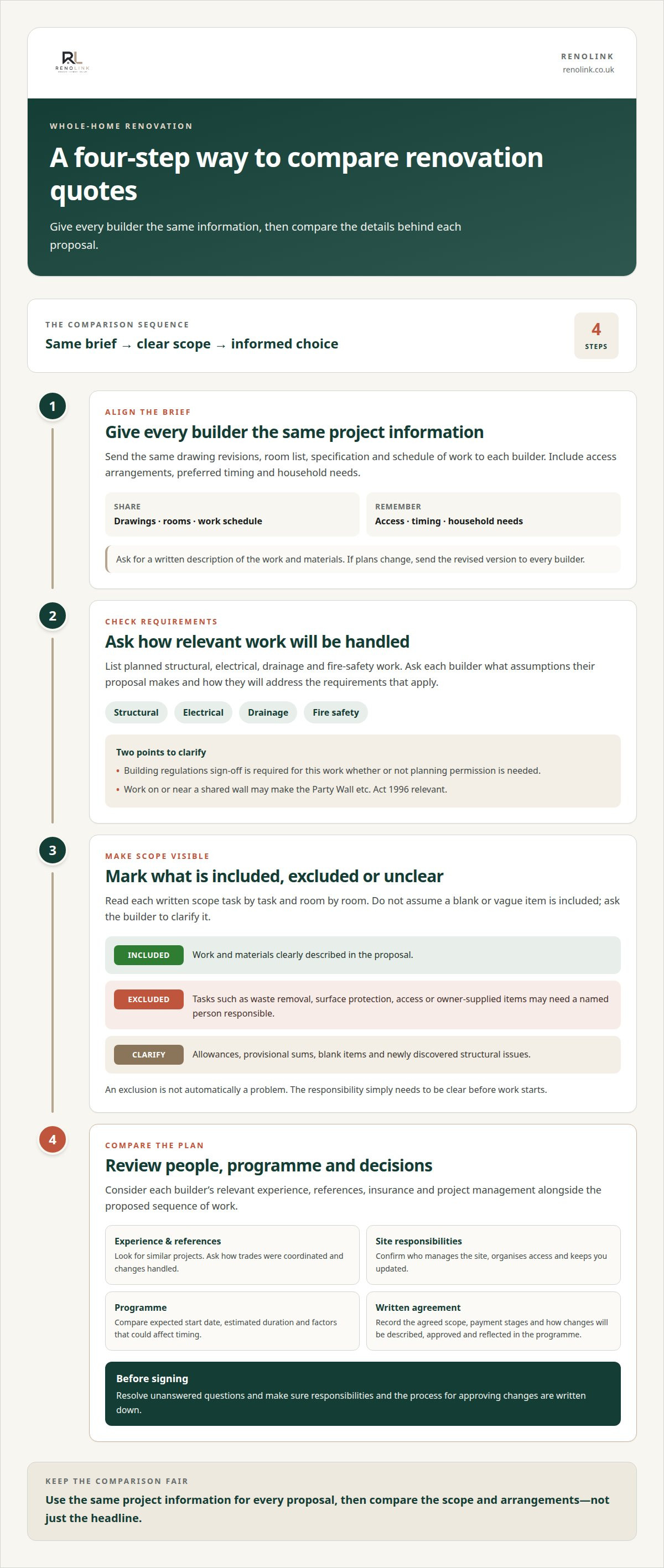
Send every builder the same drawing revisions, room list, specification and schedule of work. Include access arrangements, preferred timing and household needs, such as keeping a bathroom usable during part of the renovation. Request a written description of the work and materials. If plans change, send the revised version to every builder so the proposals remain comparable.
-
Check requirements affecting the quote
List planned structural, electrical, drainage and fire-safety work, then ask how each builder will address the relevant requirements. Building regulations sign-off is required for this work whether or not planning permission is needed. For work on or near a shared wall, the Party Wall etc. Act 1996 is relevant and usually requires notice to neighbours, according to the UK legislation register. Ask what assumptions each proposal makes.
-
Check references and project management
Ask for references from clients with similar whole-home projects. Find out how the builder communicated, coordinated trades and handled changes once work began. Clarify who will manage the site, organise access and keep you updated. Questions such as “Who is my main contact?” and “How will decisions be recorded?” help establish whether responsibilities are clear before work starts.
-
Compare timescales and project arrangements
Ask each builder for an expected start date, estimated duration and the factors that could affect the programme. Check whether the proposed sequence suits your plans for living in the property, including access to essential rooms. Ask how you’ll receive progress updates and how delays or revised dates will be communicated. Compare these arrangements with the scope and management plan, not just the headline price.
Checking contractor credentials, insurance and references
Review each builder’s relevant experience, insurance, references and written scope. Common exclusions include waste removal, surface protection, access arrangements and owner-supplied items. Hidden structural issues or unclear responsibilities can also disrupt the work.
-
Verify credentials and insurance
Ask for the contractor’s trading name, relevant credentials and evidence of insurance, then check that these match the business named in the proposed agreement. The Employers' Liability (Compulsory Insurance) Act 1969 sets a minimum of £5 million of employers' liability cover in the UK, according to the UK legislation register. Ask what other insurance applies to the planned work and who is responsible for protecting the property and its contents.
-
Check relevant experience and references
Request references for projects similar to yours, such as a whole-home renovation that included a kitchen or an extension. Ask past clients whether the builder followed the agreed programme, communicated clearly and coordinated trades. Look for examples that match your project’s complexity, rather than judging by photographs alone. Consider the builder’s role and how the completed work was managed.
- Read the written scope and mark each task as included, excluded or assigned to you. For example, confirm who will remove existing bathroom fittings, dispose of waste, protect floors and make good affected surfaces. An exclusion is not automatically a problem, but responsibilities must be clear before work starts. Ask how newly discovered structural issues will be raised and how approval will be obtained before extra work begins.
- Compare each builder’s arrangements for access, protection, waste handling and trade coordination. Ask who manages the programme, who will be your main contact and how updates will be shared. Check that the expected start date and estimated duration reflect the proposed sequence and your household’s access needs. Clear responsibilities show how each builder plans to manage the project from start to handover.
Exclusions and contingency arrangements
Turn every uncertainty into a written plan before work begins. Clear responsibilities and decision points help prevent unexpected site conditions from forcing rushed choices.
-
Identify contingency arrangements
Ask each builder how the team would respond if opening a wall revealed a concealed pipe route or another unexpected condition. Agree who will document the issue, explain its effect on the planned work and pause affected tasks while you decide what happens next. A contingency is not permission to proceed with extra work without discussing it first.
-
Set a contingency plan
Write down how you and the builder will handle decisions outside the agreed scope. Name the person who will discuss options with you, explain how you’ll receive the information and record how your decision will be documented. A clear sequence is: describe the discovery, explain the possible responses, record your approval, then arrange the revised work.
- Review exclusions by task and room, not as a general note. For example, establish who will arrange access to concealed services, protect nearby finished surfaces and reinstate areas disturbed during investigation. If a task is outside the builder’s responsibility, record who will coordinate it and when it needs to happen. This helps prevent gaps between different parts of the project.
- Agree how site discoveries will be distinguished from requested changes. A hidden defect, such as damaged timber beneath a floor, is different from choosing a new finish after work starts. Ask the builder to record the issue, proposed response and any effect on the sequence of tasks. Keep these decisions with the project documents so everyone can follow the same agreed plan.
Agreeing scope, price and changes in the contract
Before appointing a builder, put the agreed work, terms and process for changes in writing. This turns your quote comparison into a clear record of what to expect.
-
Clarify quotes, estimates and fixed prices
Check whether you have an estimate or a written quotation. An estimate indicates the likely price, while a quotation prices a defined job and becomes binding once accepted. Ask what information supports the figure, how long it remains valid and what could change it. If materials have not been selected, make sure each allowance explains how your choice affects the price.
-
Review the written contract
Match the contract against the final quotation before signing. Confirm the scope, price, payment stages and programme, then check the named contracting entity and proposed arrangements. HM Revenue & Customs states that a VAT-registered firm must add 20 percent VAT to its price. Check whether VAT is included in the quoted figure and identify any items you will pay for separately.
- Keep the agreed drawings, schedule of work, quotation, clarifications and exclusions with the contract documents. Check that every revision reflects the same scope, so earlier assumptions do not conflict with the final agreement. Confirm the builder has appropriate insurance and ask what workmanship or materials warranties apply. A written record gives both parties a clear reference if questions about the agreed work arise later.
- Agree how proposed changes will be described, priced and approved, including any effect on timing. Set out who can approve them and require written agreement before changed work proceeds. Confirm when each payment stage is due and what progress it relates to. For help finding suitable builders and comparing renovation quotes, tell us what you are planning.
RenoLink: Whole home renovations
RenoLink helps homeowners planning whole-home renovations find suitable builders and compare quotes. It connects you with verified local builders and helps clarify project briefs and quote details, giving you a clearer basis for comparison. This is useful when your project covers several rooms or combines different types of work, such as kitchen and bathroom renovations.
Share your project plans and the details that matter, including your preferred scope and timing. Clear information helps builders assess whether the project suits their experience and availability, and gives you a more useful basis for comparing proposals. RenoLink also covers kitchen renovations, bathroom renovations and home extensions.
If you’re planning a whole home renovation, contact RenoLink to discuss your project.
Take the next step with a clear brief
Before choosing a builder, decide what matters most to your household during the renovation. You might prioritise keeping certain rooms usable, coordinating work around family routines or having one clear contact for updates. A short list of priorities helps you judge which proposal suits how you plan to live during the work, not just the finished result.
As you compare whole home renovation quotes, keep your priorities beside the written project details. This gives you a practical reference when discussing next steps with a builder. RenoLink helps clarify renovation briefs and quotes, so you can move towards a well-matched project discussion.
Contact RenoLink to discuss your renovation. A considered start can make the decisions ahead feel more manageable.
Frequently Asked Questions
What should a whole-home renovation quote include in the UK?
A useful quote identifies the property, the work covered and the materials or finishes allowed for. It should also state assumptions, exclusions, provisional sums, VAT treatment, timing and payment arrangements. For example, if you expect a new kitchen floor, the quote should clarify whether it includes preparation, supply, fitting and finishing. These details show what the proposal actually covers.
How can I compare labour, materials, VAT and provisional sums across renovation quotes?
Compare each heading separately, using the same rooms and work as your reference. Check whether labour and materials are listed separately and whether material descriptions specify quality or finish. Note the VAT treatment and match each provisional sum to the work it covers. If one quote includes an allowance for bathroom tiles and another does not, clarify the missing scope before comparing totals.
How many renovation quotes should I get, and how should I check builders’ credentials and references?
There’s no single number of quotes that suits every renovation. Focus on proposals detailed enough to compare against the same brief. Review each builder’s relevant credentials and insurance, and check that the contracting name matches the quote. Ask homeowners with similar projects for references, including how the builder handled communication, site organisation and unexpected changes. Their experience can help you understand what the working relationship may be like.
How should payment schedules, variations and delays be handled in a renovation contract?
Set out payment stages in the contract, linking each payment to a clear point of progress. Specify how a variation must be written up, approved and recorded before the changed work begins, including any effect on the programme. Agree how the builder will notify you of delays, explain their cause and update the expected completion date. Keep revised schedules and approvals with the contract documents so everyone has the same record.

